
Why Your Brain Tricks You Into Losing Money
By Sandeep Handa | Co-Founder, Aspyra Partners
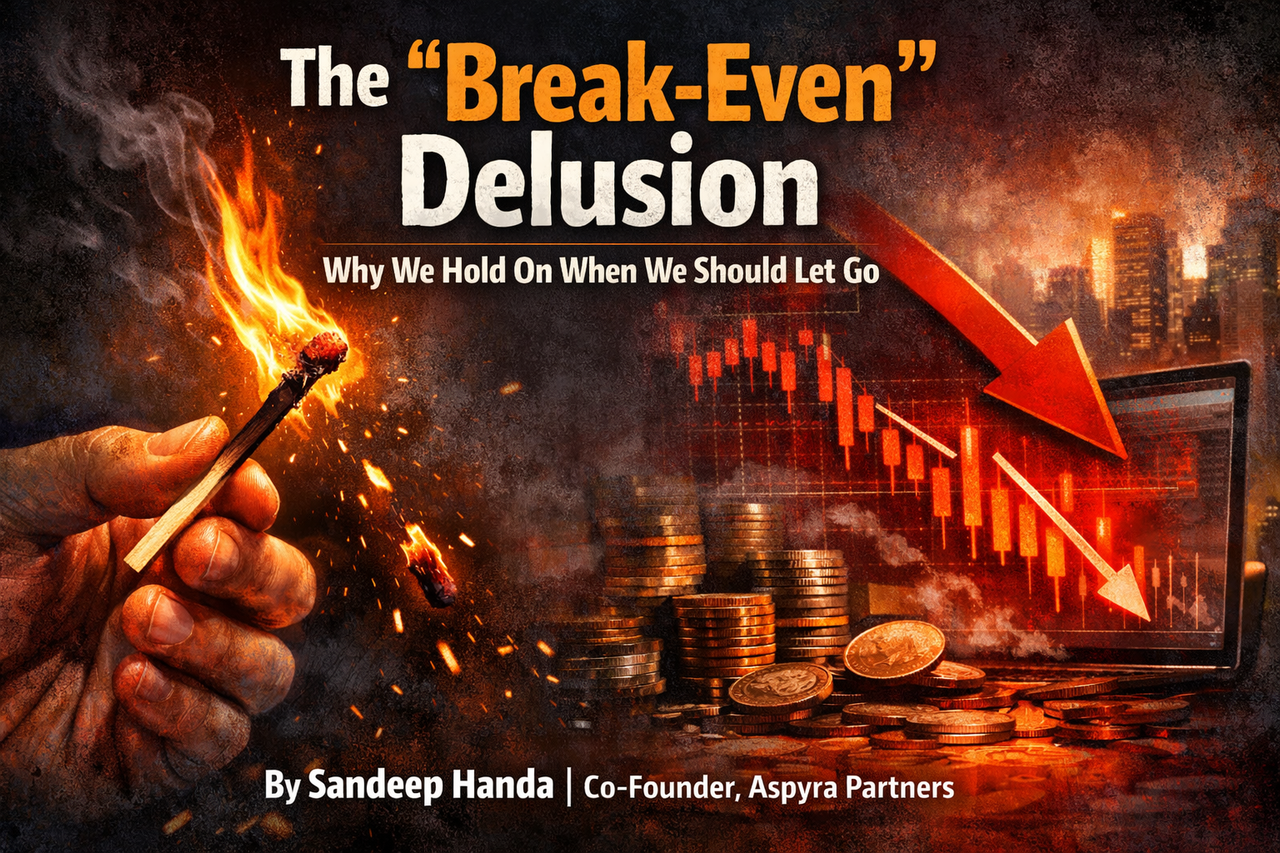
Imagine you are holding a burning matchstick. It has burned down to the end and is starting to singe your fingers. What do you do?
You drop it immediately. Instinct takes over. Your brain senses the damage, and you eliminate the source of the pain without a second thought.
But what happens when that burning match is a stock in your portfolio? Strangely, human instinct flips upside down. Instead of dropping it, we hold on tighter. We watch the portfolio bleed, and we make a silent, desperate bargain with the market: "Just let it get back to the price I bought it at. Once I break even, I will sell it and move to safer mutual funds."
I had a conversation exactly like this last Tuesday.
An investor sat across from me, looking at a portfolio where several once-solid legacy companies had dropped 20% to 30%. The market had shifted. The businesses were losing relevance. He knew this. Yet, he was completely paralyzed.
Why do intelligent, rational people suddenly become irrational when their investments turn red?
Why We Protect Our Losers and Punish Our Winners
If you are currently holding onto a declining asset just to avoid seeing a red number become permanent, please understand this: It is not a failure of intelligence. It is a hardwired glitch in how the human brain processes risk.
In behavioral finance, this phenomenon has a name. It is called the Disposition Effect—our frustrating tendency to sell our winning investments too early, while holding onto our losing investments for far too long.
To understand why you are trapped, you have to look under the hood of your own psychology. The Disposition Effect is driven by a powerful survival instinct called Loss Aversion.
Behavioral economists have proven something fascinating: the psychological pain you feel when losing ₹10,000 is roughly twice as intense as the joy you feel when making ₹10,000. Your brain literally registers financial loss as a physical threat.
Because of this, we play mental gymnastics to avoid the pain:
- The "Paper Loss" Illusion: As long as you hold that struggling stock, your brain tells you it is only a "paper loss." There is still a glimmer of hope. But the moment you click "sell," the loss becomes permanently real. Selling forces you to admit you made a mistake, triggering immense psychological regret. To protect our ego, we do nothing.
- Locking in the "Win": Conversely, when a stock goes up slightly, we are quick to sell it. Why? Because we want to lock in that feeling of success and avoid the anxiety of watching the profits disappear.
This behavior directly contradicts the oldest, most proven rule of wealth creation: "Cut your losses short and let your winners run." By falling victim to the Disposition Effect, you inadvertently engineer a portfolio that is constantly drained of its best performers and left heavily weighted with dead wood.
The Cold Math of "Waiting It Out"
The biggest trap of the break-even mentality is that we let hope replace mathematics.
If a company falls by 30%, it does not need a 30% gain to get back to your original value. It needs a 43% gain just to break even. If a stock drops 50%, it requires a massive 100% gain just to get you back to zero.
Ask yourself objectively: If a company is currently losing market share and struggling to adapt to a changing world, what are the odds it will suddenly outperform the market by 43%?
The market does not know what you paid for a stock. It does not care about your break-even point. It only cares about the future earnings of that company.
Stop Starving Your Winners
When I see investors hesitating to clean up a red portfolio, I ask them to imagine they own a team of racehorses.
You have a limited amount of premium food (your capital). One of your horses is getting old, slowing down, and consistently losing races. Another horse is young, fast, and winning easily.
What is the logical move? You feed the winner.
Yet, by holding onto struggling stocks, you are actively choosing to starve your winning horses just to keep feeding the losing one. You are risking your hard-earned money hoping the slow horse magically learns to run fast again, while the actual winners are leaving you behind.
The Hidden Cost: Time
The true cost of holding a losing stock isn't just the 30% drop. It is the invisible killer of wealth: Opportunity Cost.
Let’s say you hold onto that struggling stock, and it takes five long years to finally limp back to your break-even price. You might exhale and feel relieved because you "didn't lose any money."
But you did lose something far more valuable.
During those same five years, that exact same capital could have been deployed into a well-diversified mutual fund basket, compounding quietly over time. By stubbornly waiting to break even, you didn't save your wealth—you sacrificed half a decade of potential growth that you can never get back.
The Strategic Pivot
Building long-term wealth requires a system that is stronger than our human biases. It requires stepping away from the daily anxiety of holding vulnerable, concentrated stocks and shifting toward a balanced approach. This is where professionally managed mutual funds come in—allowing fund managers to actively cut the losers and ride the winners on your behalf.
If your portfolio is carrying the weight of disrupted stocks, I invite you to change your perspective.
Taking a realized loss today is not a defeat. It is simply the strategic cost of admission to a better portfolio tomorrow. Drop the burning match. Clean the slate. Consider shifting your focus to the winning horses, and build a system that lets you sleep peacefully while your money actually works for you.
Sandeep Handa Co-Founder, Aspyra Partners
Disclaimer: Mutual Fund investments are subject to market risks, read all scheme related documents carefully. The information provided in this article is for educational purposes only and does not constitute financial advice. Past performance is not indicative of future returns.